Free shipping to Spain on orders over €100
Spain: Free shipping on orders over €100 | Europe: Free shipping on orders over €150

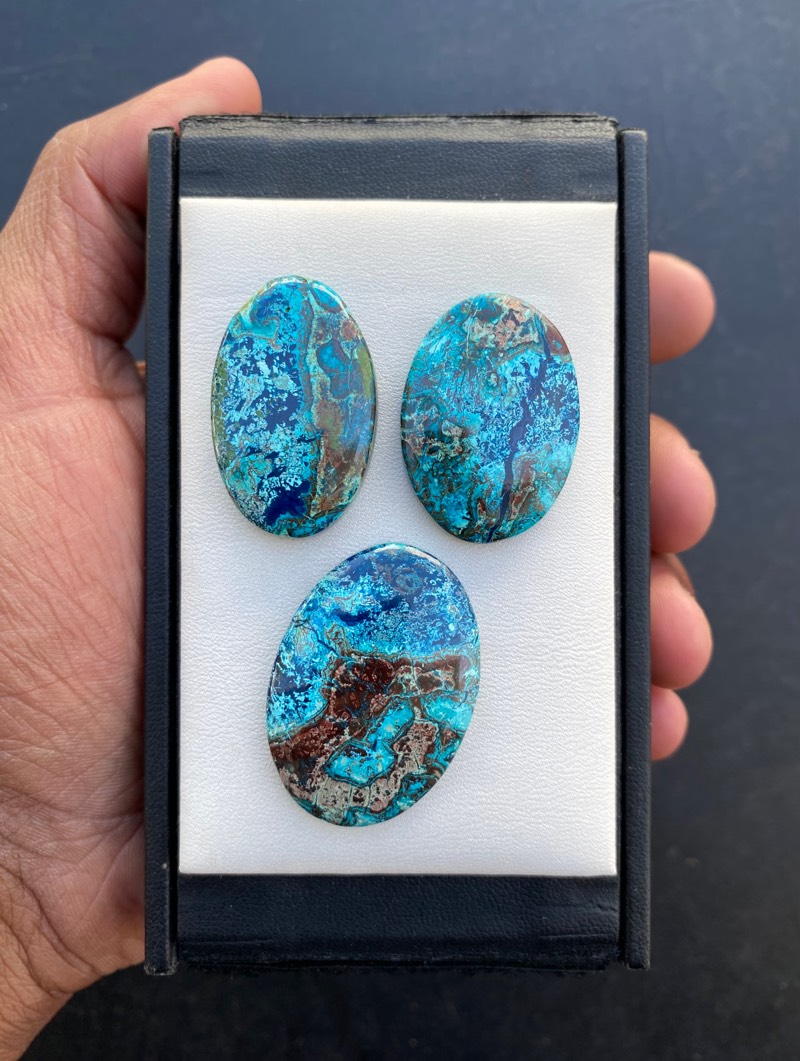


Today we are going to talk about Shattuckite, a relatively uncommon gem within the world of jewelry, but which has aroused growing interest among designers and gem collectors for its intense blue color and characteristic mineralogical structure.
Although it is not a usual stone in traditional fine jewelry, its presence in designer pieces and mineralogical collections has been increasing in recent years. If you want to see available specimens, you can consult the corresponding category at https://samsaragemstones.com/comprar-piedra-natural/shattuckita/
Shattuckite was first described in the early twentieth century and takes its name from the Shattuck mine, located in Arizona (United States), where the first specimens were identified.

It is a mineral that appears mainly in copper-rich areas and is usually found associated with other secondary copper minerals such as malachite, chrysocolla, azurite, or cuprite. Due to this mineralogical association, in many cases shattuckite appears forming complex aggregates with these species.
From a commercial standpoint, it is not a mass-produced gem. Most of the material used in jewelry comes from Africa, especially Namibia and the Democratic Republic of the Congo.
In the ornamental gem market, shattuckite is valued mainly for its intense blue color, which can occasionally resemble azurite or certain types of high-quality chrysocolla.
Shattuckite is a hydrated copper silicate whose chemical formula is Cu₅(SiO₃)₄(OH)₂.
It crystallizes in the orthorhombic system, although in gemology it is usually found more commonly in the form of fibrous or massive aggregates rather than well-defined crystals.
Its hardness is approximately between 3.5 and 4 on the Mohs scale, which indicates that it is a relatively soft material compared to many traditional gems used in jewelry.
The luster is usually vitreous to silky depending on the structure of the mineral aggregate. As for transparency, most specimens used in jewelry are opaque.
The characteristic color is intense blue, although tonalities can appear that vary between dark blue, bluish-green, or blue with veins associated with other copper minerals.
A distinctive characteristic of shattuckite is its fibrous or radial texture when observed under magnification, which helps to differentiate it from other blue-colored minerals.
Although originally identified in the United States, most of the gemological material currently available comes from Africa.
Namibia is one of the best-known producers, especially in mining areas rich in secondary copper minerals. The Democratic Republic of the Congo has also provided interesting material for lapidary work.
In these deposits, shattuckite usually appears in association with other copper silicates and carbonates, forming complex mineralogical masses that are subsequently selected for ornamental use.
The origin can influence the appearance of the material, especially when presented combined with other minerals that generate interesting patterns or color mixes.

Shattuckite is rarely synthesized or directly imitated, mainly because its market is relatively specialized.
However, it can be confused with other blue copper-rich minerals, such as chrysocolla, azurite, or certain composite materials that contain mixtures of several minerals.
In the ornamental gem market, stabilized or resin-impregnated materials may also be found to improve durability during the cutting and polishing process.
For precise gemological analysis, identification is carried out through microscopic observation, mineralogical analysis, and study of the mineral associations present in the sample.
Shattuckite forms as a secondary mineral in oxidation zones of copper deposits.
When the primary copper minerals present in a deposit are altered due to chemical processes and interaction with water and oxygen, a wide variety of secondary minerals can be generated.
In this geological environment, the liberated copper reacts with silica and other elements present in the host rock, giving rise to the crystallization of copper silicates such as shattuckite.
This type of formation explains why shattuckite frequently appears associated with other secondary copper minerals within the same deposits.
In jewelry, shattuckite is used mainly as an ornamental stone, especially in cabochons or carved pieces.
Due to its relatively low hardness, it is not usually used in jewelry that may be subjected to intensive wear, such as daily-wear rings.
However, it works very well in pendants, earrings, or collection pieces where mechanical impact is lower.
The material is normally cut as a cabochon to highlight its color and natural patterns, especially when it appears combined with other minerals that generate interesting visual contrasts.
The value of shattuckite depends mainly on color, material homogeneity, intensity of blue, and polish quality.
The most valued specimens usually present intense and uniform blue, with good color saturation and few visible fractures.
Pieces that show natural patterns generated by the association with other copper minerals can also be attractive, provided that the overall result is aesthetically balanced.
The size of the piece can also influence its valuation, especially when it comes to high-quality material suitable for large cabochons.
To correctly evaluate shattuckite, it is important to first observe the quality of the color. A deep and uniform blue is usually one of the most sought-after traits.
The second aspect is the structure of the material. Pieces with good mineral compaction usually offer better results during cutting and polishing.
It is also advisable to check for the presence of fractures or fragile zones, as they can affect both durability and the final appearance of the gem.
Finally, when the material appears mixed with other minerals, it is important to evaluate whether the resulting pattern adds aesthetic value or generates an irregular, unattractive appearance.
To expand the general criteria for gemological analysis you can consult the article at https://samsaragemstones.com/informacion-gemologica/que-es-la-gemologia-2/
Shattuckite is an uncommon gem within conventional jewelry, but it offers great interest for designers and collectors seeking different materials with strong mineralogical identity.
Its intense blue color, its relationship with copper deposits, and its mineralogical associations make it an ornamental stone with its own personality within the gemological world.
Understanding its properties, origin, and mechanical limitations is fundamental to working correctly with this material in jewelry design.
If you are interested in incorporating shattuckite into your designs or your gemological collection, it is advisable to select natural specimens with good color, compact structure, and quality polish. Working with correctly identified and well-selected gems guarantees jewelry pieces with greater technical and aesthetic value.


